
Solving the wrong problem is expensive.


When the path to your vision keeps getting reset by stakeholder concerns and the board's hesitation, the cost is rarely in the analysis. It's in the diagnosis that hasn't yet been done.

Vision alone is not enough. The teams who have to deliver it need the confidence to move forward together - and that depends on rigorous diagnosis and a clear, agreed view of how success will be measured. But both are often left out in the stampede to execution. That is the discipline at the core of our work: we unlock the confidence that turns vision into action.

Where that discipline is missing, the cost shows up in three patterns that can take the wind out of your sails.

Patterns that limit the power of great vision:

  1. Decision gridlock. You may be clear on the vision, but stakeholder commitment is locked up in uncertainty and a lack of agreement on how success will be measured. Progress stalls, your vision loses its edge as conditions change, and the energy diffuses into operational activity.

  2. Incoherence. Your vision has caught fire, blazing through the organisation. At first this is gratifying. But then competing interpretations of your vision emerge, priorities scatter in all directions, and resources spread thinly across them. The organisation is busy but not progressing.

  3. Drift. Execution started with focus across the team, but operational pressures gradually pull the organisation away from your vision. Old measures guide daily decisions and priorities, and your heading begins to move - imperceptibly at first, then the gap widens.

Strategy

Strategy is not a recommendation or a plan. It is the coherent set of choices that emerges from a diagnosis you can defend - to your board, your stakeholders, and yourself. We do the diagnostic work that turns vision into something executable, and surfaces the problem worth solving before the commitment is made. 

Planning

A clear decision still has to become a path. We work alongside your team to architect the pathway from strategy to commitment - building the evidence that lets the board agree without deferral, and the case that turns key stakeholders into allies of the change. The plan is the consequence of the decision, not a substitute for it.

Transition

Execution begins with focus and drifts under operational pressure. We help you tell the difference between adapting tactics and abandoning strategy, and we keep the diagnostic discipline alive so the conviction that earned the original commitment is preserved as the conditions change.

Problems we help clients with.

  • When the vision or strategy is clear, but the commitment is not

    Has the strategic direction been clear to you for some time, while stakeholder concerns keep delaying the commitment to act on it?


    Are board papers being revised to satisfy criteria that have not been openly agreed?


    Are debates that should be settled by evidence being settled by negotiation?

  • When the priorities don't add up to a strategy

    Are several initiatives in flight, each with its own logic and its own sponsors, with no clear answer to which problem is core?


    Has the work of choosing what to commit resources to first been deferred while the work continues?


    Are resources spread thin across competing priorities, with progress on none of them?

  • When execution started with focus, but pulled away from the original intent

    Has operational pressure quietly redirected the program away from the ambition that started it?


    Is the leadership team unsure whether you are adapting tactics or quietly changing strategy?


    Is the cost of not recommitting, or not recalibrating, accumulating in the background?
Examples of how we have helped clients achieve their goals.

Strategy to execution plan for a mutual bank

The 5-year strategy for a mutual bank had run its course - it was time to develop a fresh strategy that reflected the bank's strengths and legacy in the context of changing conditions. 


The Polaris team worked with the bank's board and executive team to refresh its strategic direction based on a robust diagnosis of the bank's situation and capabilities. With the strategy set, we then worked with the executive team to translate this to a practical plan to realise the bank's objectives and purpose. 


As a result, the board and executive team were clearer about their shared vision, the initiatives to focus resources on, and the bank's priorities. 

Testing a mutual bank's strategy by talking directly to customers

A mutual bank needed to validate assumptions behind their refreshed strategy before investing in initiatives to pursue their ambitious growth targets. They needed deeper insights into the unique dynamics of their community than conventional research methods could provide.


Polaris deployed conversational AI technology that combined robust quantitative analysis with rich qualitative understanding, delivering insights previously only available through resource-intensive interviews. We mapped findings directly to strategic implications, revealing crucial insights about key influences on banking decisions, such as family and career transition.


As a result, the bank gained strategic clarity, actionable product development opportunities, and reduced investment risk. As their CEO noted, "The insights are of very high quality... For us, it's now about acting on these insights."

Strategy development and planning for professional member association

A steady decline in member numbers was affecting financial sustainability; what strategies should be deployed to reverse the trend?


Polaris took a pragmatic approach to developing the strategy, collaborating closely with the board and executive team. This involved diagnosing the core challenge to reduce the scope and complexity of the issues, then working with the board and executive to define strategies and a roadmap, and, finally, recommending practical actions to stabilise financial performance and establish a foundation for growth. Polaris also helped to design a top-down organisation structure that streamlined business operations and brought together capabilities for greater community impact.

Commercialisation review for a professional member association

A new product had been designed and deployed, but traction was slower than expected; what could the leadership team do to grow into an opportunity they knew was there?


Polaris took a fact-based approach to rapidly identify and size market segments, assess needs and trends affecting the opportunity, recommend segment prioritisation, and develop an analysis of required capabilities. By conducting a self-assessment survey with the client, the team also helped gauge key capabilities gaps so that investment could be directed to drive impact. The approach and insights from the project not only helped the client team pivot to a clear market (with immediate results) but also led to a broader assessment of ‘where to play’ for the organisation.

How we are different

Polaris is a decision architecture firm. Most strategy consulting helps organisations execute on problems they have already defined; decision architecture starts earlier, discovering which problem is actually worth solving before resources are committed to it. The discipline is rigorous, but the conviction underneath it is simple: visions worth pursuing deserve the diagnostic work that lets them be pursued with greater confidence.


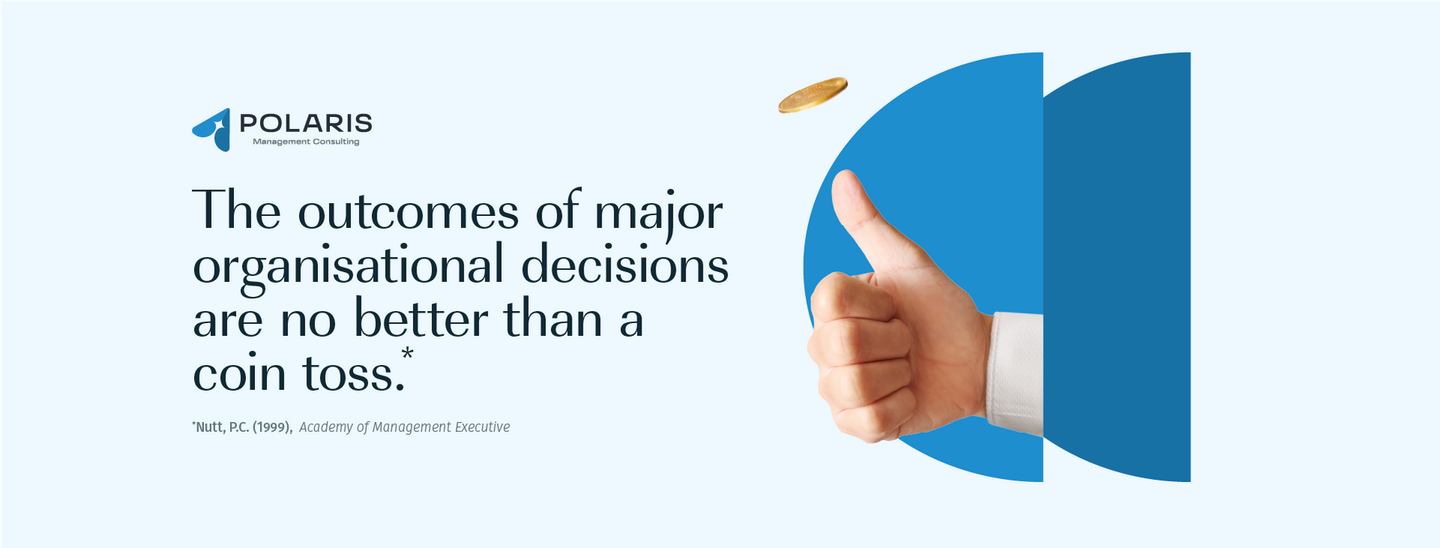
The work is anchored in research that should change how leaders think about strategic decisions. Tracking consequential organisational decisions over two decades, the evidence found that outcomes were statistically no better than a coin toss - and that failure rates were four times higher when leaders committed to a solution before diagnosing the problem. The organisations that beat those odds are not smarter or better resourced. They are more disciplined about the question they ask before the work begins.


That is the work we do. Every strategic decision Polaris has supported clients in taking to their board has been agreed without deferral - because the analytical groundwork answered whether we were solving the right problem, not just whether we could execute the chosen strategy. Our research has reached more than 3,500 Australians across engagements, and challenged our clients' assumptions as often as it has confirmed them.


In a world full of same-same advice, this is the difference.

Get our fortnightly Polaris Signals newsletter

This is a paragraph. Writing in paragraphs lets visitors find what they are looking for quickly and easily.

We curate observations from the work, links to research worth your time, and access to Polaris perspectives that go deeper than what you see on LinkedIn. Subscribe to join a quiet community of leaders thinking about the same questions you are.