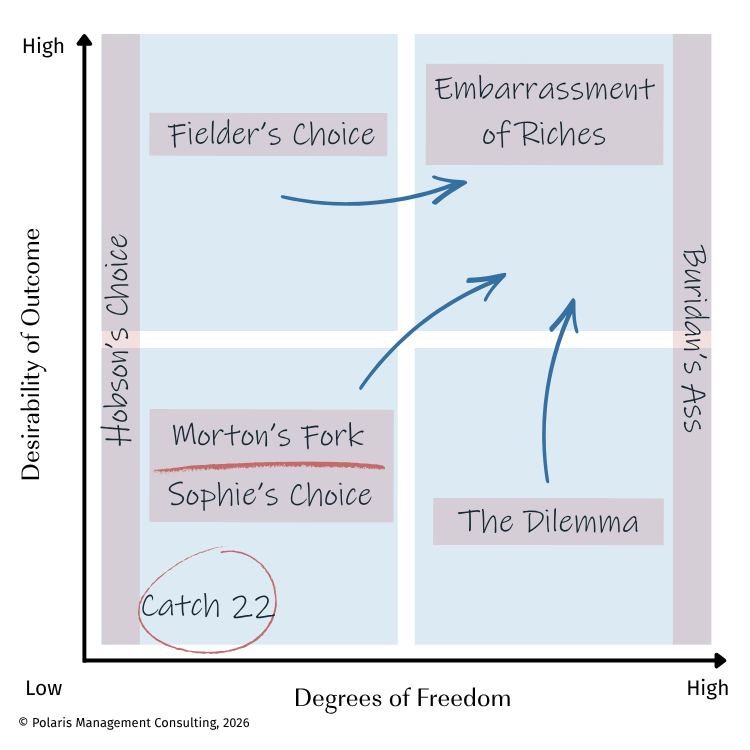
When faced with high-stakes decisions, the available choices often appear set before anyone has had an opportunity to test them. A merger partner is assumed early in the process (but did anyone ask what a good merger looks like first?), a technology programme already has a shortlist of solutions before the benefits case has been agreed.
It's an understandable process - by hardening a limited set of choices, the decision becomes simpler and easier to make, clearing the way to 'getting on with it'. This is decision efficiency winning over decision effectiveness - which can lead to net inefficiency if the decision was wrong.
So often, the decision frame is set by consensus or by tradition, which is rarely the best one for a situation that hasn't been properly assessed. The well-trained muscle of day-to-day, efficient common sense tends to elbow its way to the front of the decision-making consciousness, channelling two or three paths to the exclusion of all others. This means organisations commit resources, run programmes and focus attention on choices whose framing was never tested. By the time the cost of a poor frame becomes apparent, the commitment has usually been made - and 'sunk investment' becomes the stronger argument.
This is when solving the wrong problem becomes expensive. The trick is to step back for just long enough to test whether the frame of choices sets up the best quality decision.
The missing step that makes all the difference
Good decisions depend on the quality of the choices available and on the diagnosis of the situation in which the decision is made. Diagnosis works out what the real problem actually is, revealing the paths genuinely open to us. This step is often skipped, meaning the choices for high-stakes decisions offer fewer real paths than they might, or lead somewhere less desirable than was assumed.
Decision architecture
A practical example - the Morton’s Fork of merger decision-making
A practical example of this is what we observe in mutual banking, where consolidation is a sustained trend. The merger decision is usually framed as two paths - merge, or accept the gradual disadvantage of staying small - and the logic is plausible enough, given technology costs, fixed regulatory burden and a limited resources base that is spread thinly. This looks like a Morton's fork, two options converging on the same difficult end.
But, examined properly, that fork could expand to other options if we firm up our objectives clearly. Scale isn’t necessarily the only route to the things scale is meant to provide, and starting with a merger closes off the opportunity to explore other paths to a more desirable outcome.
Decisions are rarely made in isolation. Each decision taken opens the next set of choices - decisions are the door through which new choices emerge. The path chosen reshapes the choices that follow it, and examining a situation as it really is, rather than accepting an assumed version, is the active step that keeps new ground opening rather than closing off.
We are often presented with a choice as finite - a market, a value proposition, a technology - but are we confident that the proper diagnosis has been done first?